Rebuilding the Mind of a Nation: The Education Post-War Somalia Needs, and How Daaru Salaam University Positions Itself to Deliver It
DAARU SALAAM UNIVERSITY
Mogadishu, Somalia
GRADUATION KEYNOTE ADDRESS
Rebuilding the Mind of a Nation: The Education Post-War Somalia Needs, and How Daaru Salaam University Positions Itself to Deliver It
Delivered by
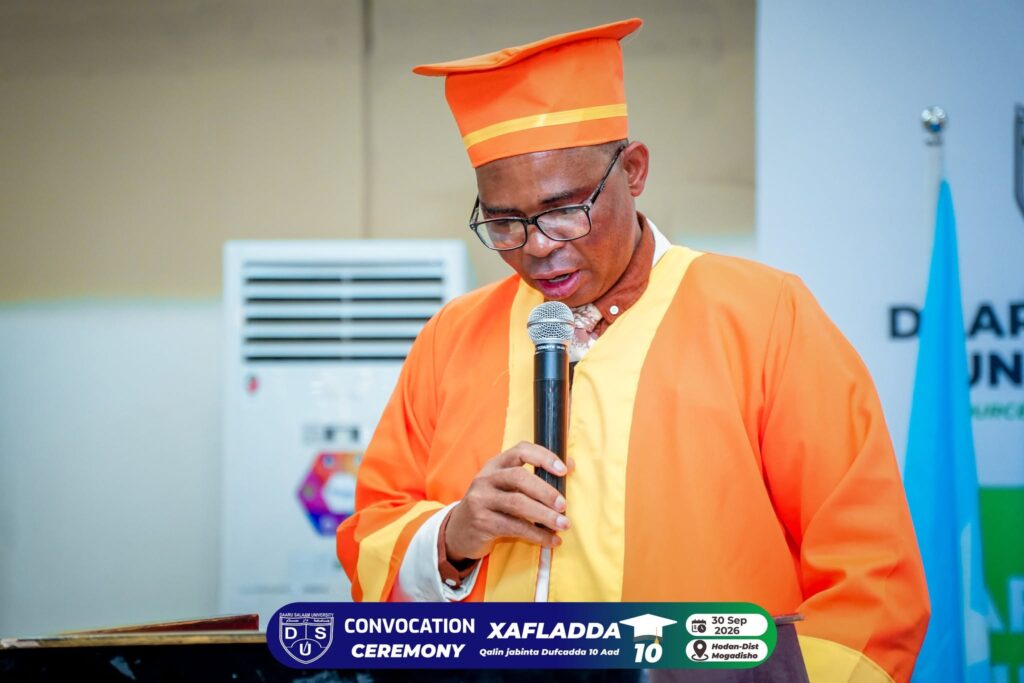
Prof. Paul Allieu Kamara
Vice Chancellor in Charge of Postgraduate Studies and E-Learning
Daaru Salaam University, Mogadishu, Somalia
Opening Protocol
Bismillahi-Rahmani-Raheem.
Honourable Chancellor and members of the University Council; distinguished government officials and representatives of the Federal Government of Somalia; members of the diplomatic corps; the Vice Chancellors and Deputy Vice Chancellors here with us; my fellow members of Senate and the academic community of Daaru Salaam University; proud parents, guardians, and families; partners from industry and civil society; members of the press; and — most of all — the graduating Class before me today: I greet you all with the deepest respect and gratitude.
It is a profound honour to stand on this podium as Vice Chancellor in Charge of Postgraduate Studies and E-Learning at Daaru Salaam University, and to be entrusted with the task of addressing this graduating class on a day that belongs, first and foremost, to you — our graduates.
I do not stand here simply to congratulate you, though I do so with my whole heart. I stand here to speak plainly, as a scholar of leadership and governance and as a son of a continent that knows the cost of conflict, about what your certificates mean at this particular moment in Somalia’s history — and about the responsibility that now rests on your shoulders and on ours as an institution.
I. A Graduation That Means More Than a Ceremony
To our graduates: you have done something remarkable. You have pursued rigorous study — many of you alongside full-time work, family obligations, and the everyday uncertainties of life in a country still writing its next chapter — and you have finished. That discipline alone qualifies you for what comes next.
But I want to be honest with you about why this occasion carries a weight beyond the individual achievement it represents. You are not simply graduating from a university. You are graduating into a nation in the delicate, difficult, and hopeful work of recovery. Somalia has endured more than three decades of conflict, state fragmentation, displacement, and the slow, patient labour of rebuilding institutions from the ground up. Every graduating class since the collapse of central authority has entered a country still assembling itself. Your class is no exception — and your class is also, I believe, part of the generation that will finish that assembly.
That is not rhetorical flourish. It is a statement of fact about where national reconstruction now stands, and about the particular kind of contribution that only educated citizens — citizens formed in the discipline of evidence, ethics, and analysis — can make.
II. What Kind of Education Does Post-War Somalia Need?
Allow me, as a scholar who has spent nearly two decades in the classroom and in the study of leadership, governance, and human development, to answer this question directly. Post-conflict nations do not need more of the same education that existed before the conflict. They need an education fit for the specific work of national repair. I want to name five dimensions of that education, because I believe Daaru Salaam University has built its mission around precisely these five.
First, an education for institution-building, not only employment.
A country emerging from state collapse does not lack ambitious people. It lacks functioning institutions — courts that rule fairly, ministries that plan competently, local governments that deliver services, universities that produce trustworthy knowledge. The most valuable graduate a post-war nation can produce is not only one who finds a job, but one who can build or repair an institution: who understands public administration, public finance, procurement integrity, and the machinery of governance well enough to make it work honestly. This is why our programmes in Public Administration and Management, and in Leadership and Organizational Development, are not peripheral to our mission. They are central to it.
Second, an education anchored in ethical leadership and integrity.
I have argued in my own research, and I will repeat it here, that Sustainable Development Goal 16.4 — the global commitment to significantly reduce illicit financial flows and strengthen the recovery of stolen assets — is not an abstraction for a country like ours. It is a daily governance challenge. Fragile states lose an outsized share of their public resources to corruption, weak financial controls, and illicit flows precisely at the moment they can least afford it. A university that trains accountants, administrators, and leaders without training their conscience alongside their competence produces technicians of extraction, not stewards of the public good. Post-war Somalia does not need more clever administrators. It needs administrators who refuse to steal.
Third, an education that restores human capability, not only human capital.
I draw here on the work of the economist Amartya Sen, whose capabilities approach has shaped my own scholarship for many years. Sen taught us to ask not only what a person produces, but what a person is genuinely free and able to do and to be — to be healthy, to be heard, to participate in the life of their community, to live with dignity. War does not only destroy roads and buildings; it narrows what people believe is possible for their own lives. The task of post-war education is to widen that horizon again — to hand people back the sense that their choices matter and their voice counts. This is the deeper meaning behind the conviction I have long carried and often repeated: that human rights are not a constraint on development, but the very power that makes development possible.
Fourth, an education that reaches beyond the capital and beyond the classroom wall.
A nation rebuilding itself cannot afford an education system that only serves those who can relocate to a handful of urban centres. Somalia’s talent is distributed across its regions, across its diaspora, and increasingly across a young population that has grown up with a mobile phone in hand. Education for reconstruction must be designed to travel — to reach the civil servant in a regional administration, the health worker far from Mogadishu, the diaspora professional who wants to invest their expertise back home without relocating permanently.
Fifth, an education that produces research on our own problems, in our own context.
For too long, the policies that govern fragile and post-conflict states have been written elsewhere, about us, without us. Post-war Somalia needs its own generation of researchers — in economics and policy, in human resource management, in leadership studies — who can produce evidence rooted in Somali realities and defend it with the same rigour as any scholar anywhere in the world. A country cannot be governed well on borrowed data.
III. How Daaru Salaam University Positions Itself for This Work
I do not raise these five dimensions as a wish list. I raise them because they describe, quite precisely, the choices Daaru Salaam University has already made — choices I have had the privilege of helping to shape in my role overseeing postgraduate studies and e-learning, and choices now carried forward in our University’s five-year strategic plan.
We have positioned our postgraduate portfolio deliberately.
Our Master’s and PhD programmes in Public Administration and Management, Human Resource Management, Leadership and Organizational Development, Business Administration, and Economics, Policy and Planning were not assembled at random. Each answers directly to one of the institutional gaps I have just described — the gaps in public management capacity, in ethical leadership, in the technical skill to plan and administer an economy still finding its footing. Alongside these, our Fundamentals of Research Education curriculum, taught from the undergraduate through the doctoral level, exists so that every graduate leaves us able to produce evidence, not merely consume it.
We have invested in e-learning as an instrument of national reach, not merely convenience.
In my own portfolio as Vice Chancellor for Postgraduate Studies and E-Learning, I have made the case again and again that for a country like Somalia — with a dispersed population, a large and capable diaspora, and security and infrastructure realities that make constant travel to a single campus impractical for many able students — e-learning is not a lesser substitute for real education. It is how we take rigorous, credentialed postgraduate education to the civil servant in Kismayo, the health administrator in Garowe, the Somali professional in Minneapolis or London who wants to bring their expertise home. A university serious about post-war reconstruction must be a university that goes to where its people are.
We are building a research culture aimed at Somalia’s own governance challenges.
Through our research and development initiatives, we are deliberately cultivating scholarship on the themes this country needs most: governance, financial integrity and the fight against illicit financial flows in line with SDG 16.4, human development, and ethical leadership in fragile and transitional states. We want a graduate of this University, whether they end up in a ministry, a regional government, a bank, an NGO, or their own enterprise, to carry with them not only a credential but a worldview: that institutions can be trusted, that leadership can be honest, and that development is, at its root, about expanding what people are free to do and to become.
We are building this deliberately, over time, and honestly.
Our University’s five-year strategic plan sets out exactly how we intend to grow this mission — how we strengthen postgraduate and doctoral education, how we widen access through e-learning, and how we build the partnerships and the research output that give Daaru Salaam University a credible voice in national reconstruction. We do not ask you to trust an institution that has not shown its plan. We have shown ours, and we invite you, as our graduates, to hold us to it.
IV. The Charge I Leave With You
Graduates, hear me clearly. The degree you receive today is not an exit from responsibility. It is an entry into it.
Wherever your certificate takes you — into government, into the private sector, into civil society, into further study, into building something of your own — I ask you to carry these five commitments with you. Build institutions; do not merely occupy positions within them. Refuse the shortcut of illicit gain, even when it is offered quietly and often. Treat every person you serve as someone whose capabilities and freedoms matter, not only as a statistic in a report. Do not let distance from the capital, or from any centre of power, convince you that your contribution is peripheral. And wherever you go, keep producing knowledge — write, research, document, question — because a nation that stops producing its own evidence stops governing itself.
You are graduating at a moment when Somalia needs precisely what you now carry: trained minds, disciplined by rigorous study, oriented toward integrity rather than extraction, and committed to the long, unglamorous work of rebuilding public trust one honest decision at a time.
Closing
To the families in this hall: thank you for the sacrifices that made this day possible. To our faculty and staff: thank you for your labour in forming these graduates. To our Chancellor and Council: thank you for the vision that continues to guide this University.
And to our graduates, once more: congratulations. Somalia’s next chapter is not yet written. Go and help write it — with competence, with conscience, and with courage.Thank you. May God bless Daaru Salaam University, and may God bless Somali